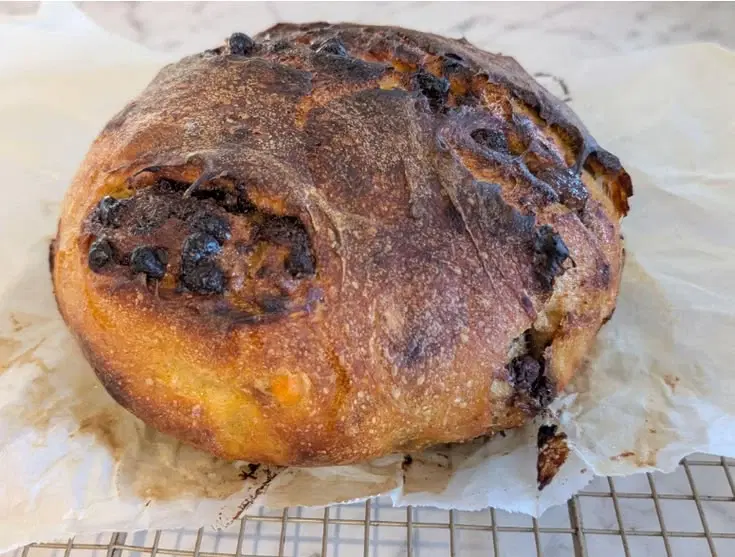
Sweet potato chocolate chip toffee sourdough boule with a tender crumb, golden crust, chocolate pockets, and overnight cold proof.
Prep
45 mins active (+ overnight cold proof)
Cook
40-45 mins
Total
18-24 hrs
Calories
295 kcal
Protein
12.4 g
Carbohydrates
50.3 g
Serves
12 slices
Fat
6.8 g
An artisan sourdough that reads like breakfast toast: roasted sweet potato adds tenderness and color, while chocolate chips and toffee bring caramel notes. Build dough strength first, then laminate the inclusions so the loaf stays cohesive. Sourdough fermentation keeps sweetness balanced, and an overnight chill makes scoring clean and oven spring strong.
This dough carries extra moisture and sugar from roasted sweet potato and inclusions. That combination softens gluten and weighs down the network, so you must front-load strength (autolyse + initial mixing/folds) and delay inclusions until the dough is elastic. Cold proofing increases dough extensibility and tones down stickiness from melted sugars, which helps with scoring and oven spring.
Score interpretation: This recipe leans treat-forward. Fermentation and sweet potato contribute structure and some phytonutrients, while chocolate and toffee tilt it toward an occasional bake. Metabolic and inflammation perspectives are closer to neutral than the overall balance, which flags more caution because of refined flour and added sugars.
Ingredients
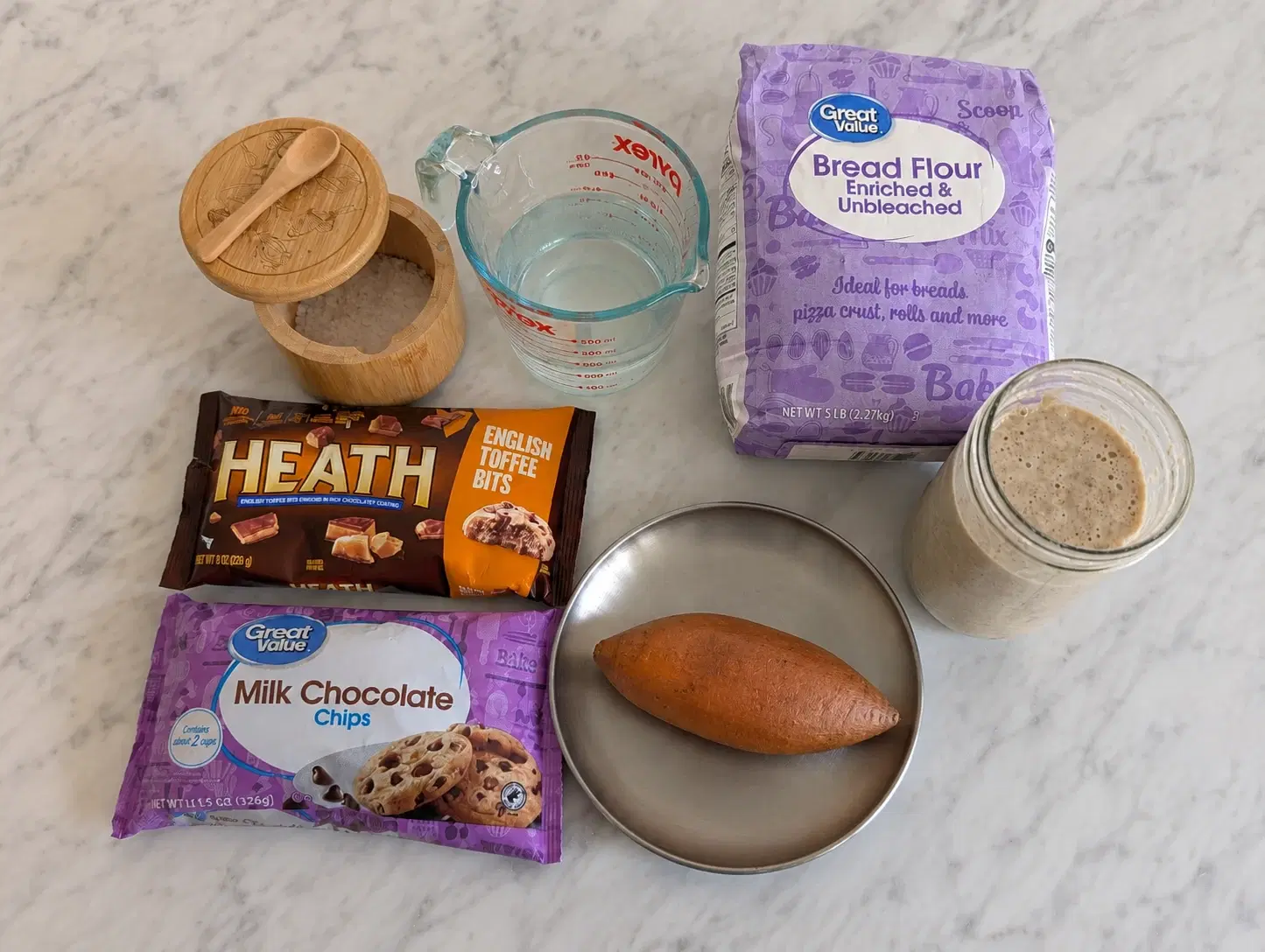
Bench scraper
KitchenAid stand mixer (or sturdy bowl for hand mixing)
Parchment paper
Ingredient notes
Use active sourdough starter at or near peak for best fermentation strength.
Bread flour gives the dough enough structure to support sweet potato, chocolate, and toffee.
Heath toffee bits melt into caramel-like pockets; chopped toffee bars can work if the pieces are small.
Chocolate chips hold their shape better than chopped chocolate during lamination and baking.
Roast and cool the sweet potato
Roast the sweet potato until very soft and slightly caramelized, then mash or puree until smooth and let it cool completely before mixing the dough.
Autolyse
Mix the flour, water, and sweet potato until combined. Rest 30 minutes, or up to 45 minutes if using the stretch-and-fold method.
Add starter and salt
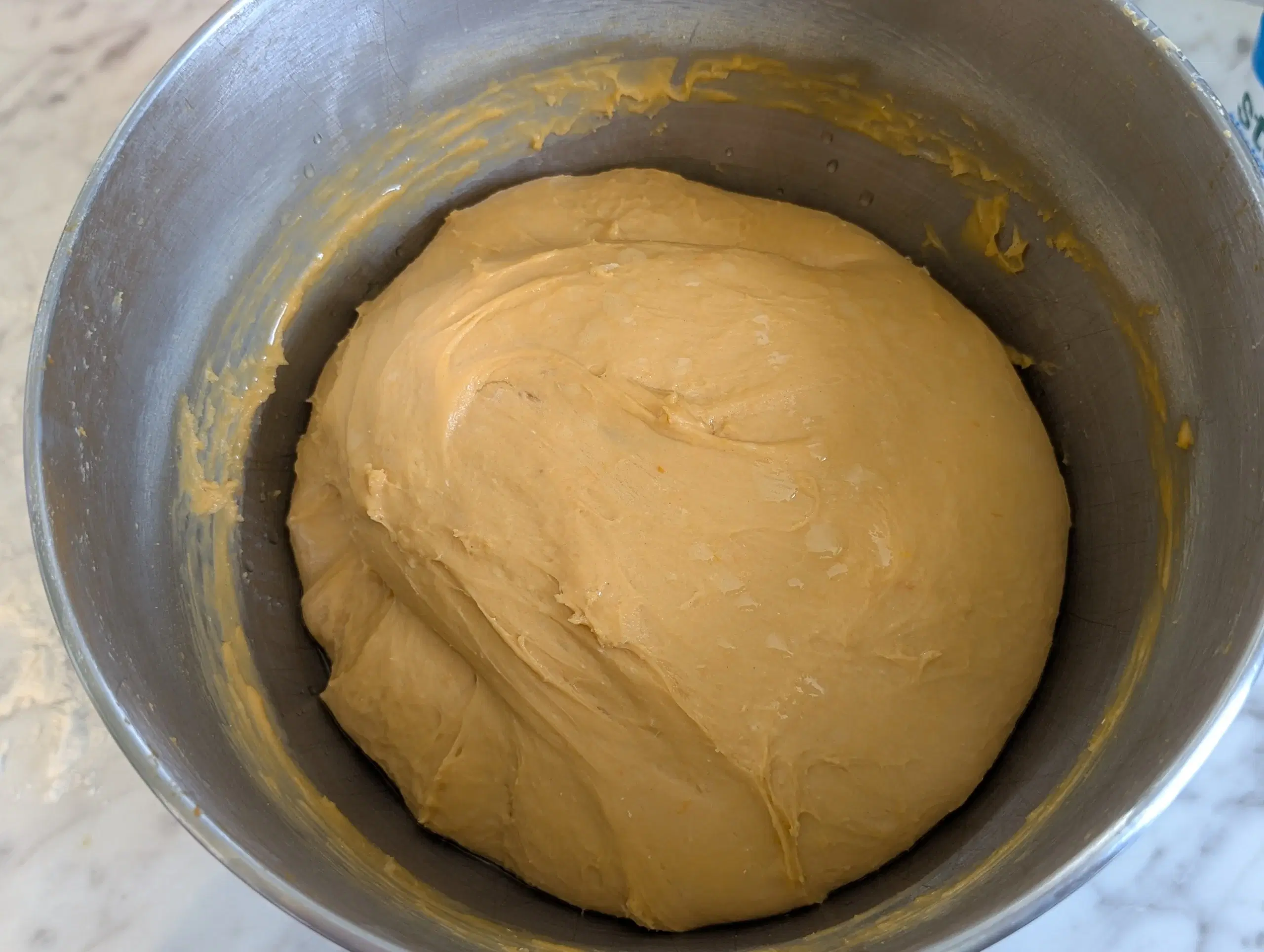
Add the starter and salt to the autolysed dough. For the mixer method, mix on speed 2 for 5 to 6 minutes until smooth and elastic. For the hand method, mix thoroughly by hand until the dough comes together.
Build dough strength
If using the mixer, let the dough begin bulk fermentation and watch for a 20 to 30 percent rise over about 2 to 3 hours. If using stretch-and-folds, perform 4 sets every 30 minutes over 2 hours, then continue until the dough looks slightly airy.
Laminate the inclusions
Turn the dough onto the counter and stretch it thin. Scatter the chocolate chips and toffee bits over the dough, leaving a small clean border around the edges, then fold it into a parcel.
Finish bulk fermentation
Return the dough to the bowl and continue fermenting until the total rise reaches about 40 to 50 percent and the dough looks puffy and cohesive.
Pre-shape
Turn the dough out, shape it into a loose round, and let it rest for 15 minutes.
Final shape and cold proof
Shape into a tight boule and place seam-side up in a floured banneton. Refrigerate 12 to 14 hours overnight.
Preheat the oven
Preheat the oven with the Dutch oven inside to 450 F for 45 minutes.
Bake
Transfer the loaf to parchment, score, and bake covered for 20 minutes at 450 F. Remove the lid and bake 20 to 25 minutes more at 425 F. Lower to 415 F if the loaf is browning too fast.
Cool before slicing
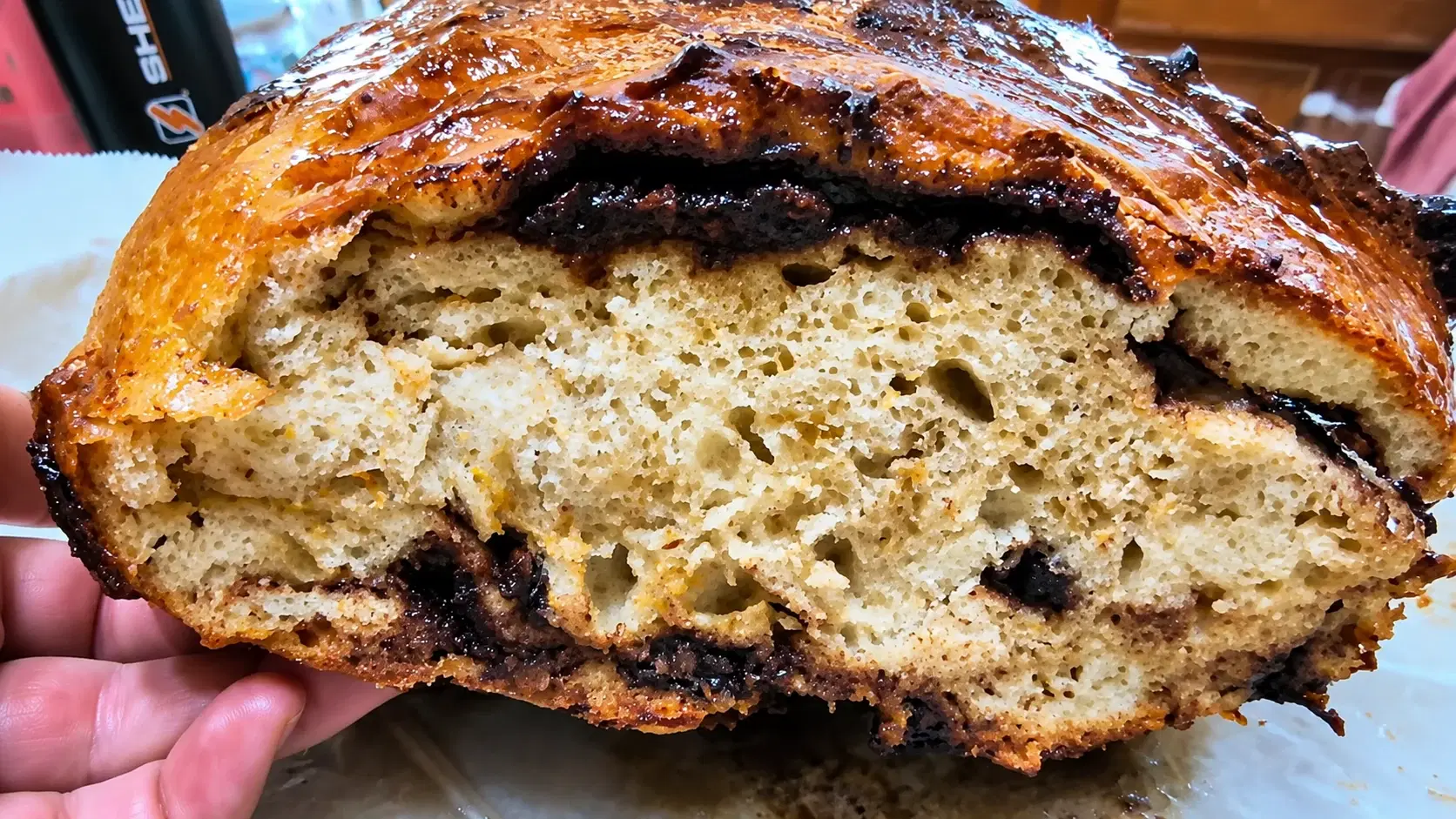
Cool for 1 to 2 hours before slicing. Aim for an internal temperature of 205 to 208 F.
The rest after lamination matters because the dough needs time to re-knit around the chocolate and toffee before shaping.
Per-serving details
Nutrition Facts
12 slices servings per container
Amount per serving
Calories
295
Protein 12.4 g
Per batch: 148.4 g
Total Fat 6.8 g
Per batch: 81.1 g
9%
Saturated Fat 3 g
Per batch: 35.5 g
15%
Total Carbohydrate 50.3 g
Per batch: 603.7 g
18%
Fiber 4.6 g
Per batch: 55.1 g
16%
Cholesterol 1 mg
Per batch: 15 mg
0%
Sodium 386 mg
Per batch: 4628 mg
17%
Vitamin A 73 mcg
Per batch: 870 mcg
8%
Vitamin C 1 mg
Per batch: 12 mg
1%
Vitamin E 0.2 mg
Per batch: 2.5 mg
1%
Calcium 28 mg
Per batch: 335 mg
2%
Iron 3.2 mg
Per batch: 38.3 mg
18%
Magnesium 38 mg
Per batch: 462 mg
9%
Potassium 266 mg
Per batch: 3189 mg
6%
* The % Daily Value tells you how much a nutrient in a serving of food contributes to a daily diet. 2,000 calories a day is used for general nutrition advice.
Nutrition is an estimate and varies by chocolate, toffee, and slice size.
This is a treat-style sourdough loaf, not an everyday plain bread.
For a less sweet loaf, reduce the toffee or use darker chocolate.
Nutrition information is automatically calculated, so should only be used as an approximation.
Optional recipe science
Bread flour: High protein provides the gluten backbone that traps gas and supports the weight of puree, chocolate, and toffee.
Water: Hydrates flour and starches; adjusts dough viscosity and enzyme mobility, especially important with puree present.
Roasted sweet potato puree: Adds moisture, sugars, and pectin-like compounds that tenderize crumb, deepen color, and speed browning.
Active sourdough starter: Supplies acids and gas; organic acids tighten gluten for shaping and improve flavor balance against sweetness.
Salt: Strengthens gluten, moderates enzyme activity, and sharpens flavor; counters perceived sweetness.
Chocolate chips: Discrete fat–sugar inclusions that resist full melt; create chocolate pockets but interrupt gluten if added too early.
Heath toffee bits: Concentrated sugar–fat pieces that soften into caramel pockets; increase browning risk at the crust.
Autolyse with puree: Enzymes and water from sweet potato speed softening of the dough. A 30–45 minute rest hydrates starches and allows gluten bonds to begin forming before salt tightens the network.
Salt timing: Adding salt after autolyse strengthens gluten and moderates protease activity, which matters with puree-rich doughs that can slacken quickly.
Strength before sweets: Chocolate and toffee are discontinuities in the gluten mesh. If added early, they interrupt strand alignment, lengthening bulk time and risking separation.
Bulk targets: Compared with lean sourdough, inclusion-heavy dough benefits from a more conservative rise. Around half expansion gives enough gas retention without over-acidifying or weakening the net.
Thermal profile: Start hot and steamy (covered) for oven spring, then finish drier and slightly cooler to avoid scorching sugars at the surface.
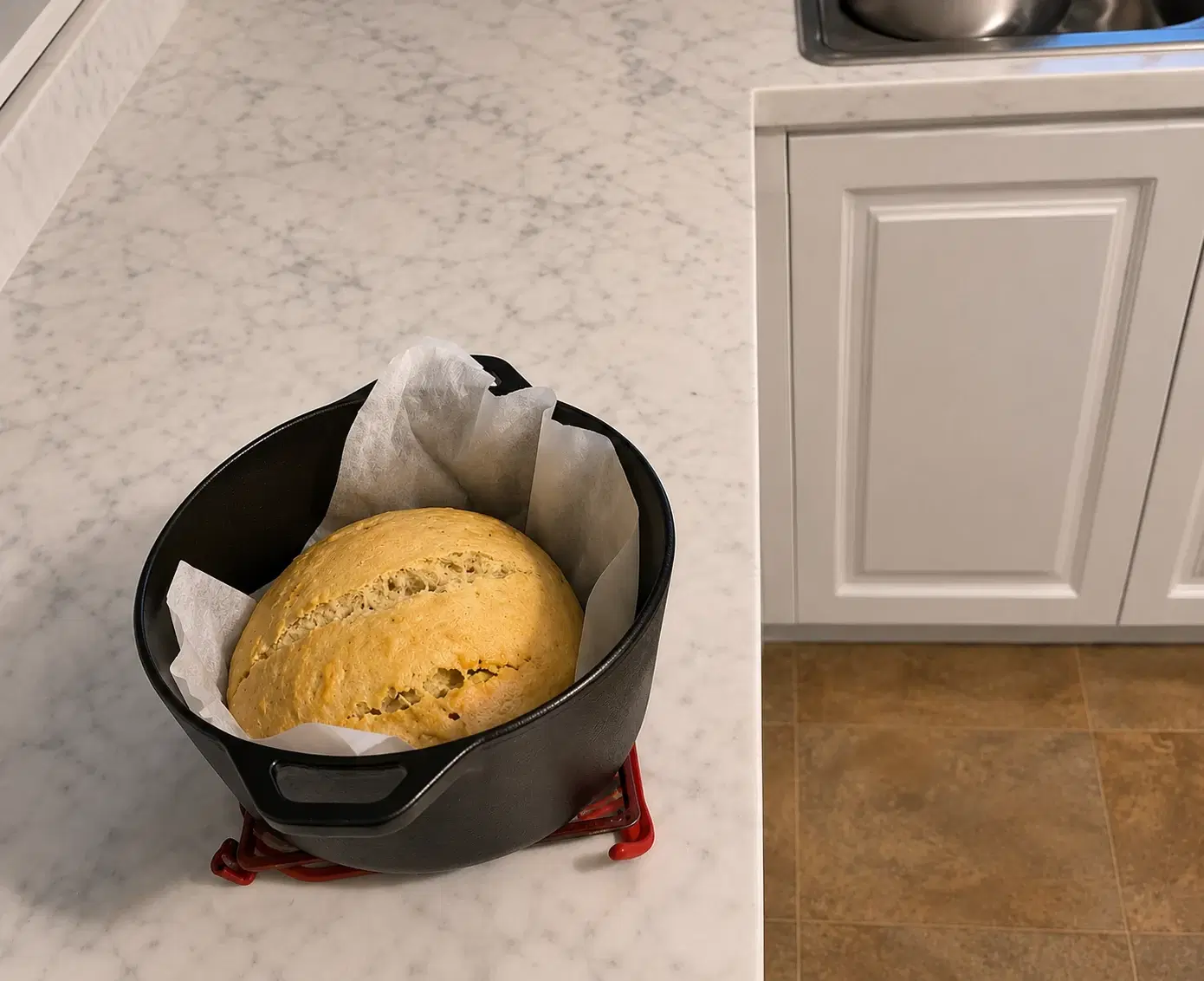
Hydration management: If your puree is especially moist, hold back 10–15 g water during autolyse and add only if the dough feels tight; this keeps structure crisp and prevents a gummy crumb.
Inclusion size and melt: Standard chips hold shape better than chopped chocolate, limiting smear. If using chopped chocolate, chill it first and reduce uncovered bake temperature slightly to protect the crust.
Flavor balance: For a less-sweet profile, keep chocolate at 100 g and toffee at 50–60 g; the sourdough tang reads more clearly and the crust caramelizes without tipping toward candy-like.
Mineral balance: If using salted toffee or salted butter–toffee bits, consider reducing added salt by 0.5–1 g to keep overall salinity in check without muting fermentation.
Fermentation temperature: Keep bulk around 75–78 F. Warmer temps accelerate amylase activity with puree present, which can oversoften dough and narrow your scoring window.
Build strength first, add sweets later, and proof cold. Those three moves keep a soft, tender crumb from collapsing under the weight of chocolate and toffee.
Keep this recipe handy
Tips, variations, storage advice, and quick fixes—all in one place.
Store wrapped at room temperature for 1 to 2 days.
For longer storage, slice and freeze with parchment between slices for up to 2 months.
Reheat slices in a toaster or 350 F oven until warm.
Because of the chocolate and toffee, this loaf has the best crust-and-crumb contrast on the first day.
I let the loaf cool longer than a plain sourdough because warm chocolate can smear and make the crumb look under-set.
If the loaf separates into layers, it likely needed more fermentation time after lamination.
If the crust browns too fast, reduce the uncovered bake temperature to 415 F.
If the dough feels weak, check that the sweet potato was not too wet and that the starter was fully active.
If the loaf spreads after scoring, it may be overproofed or shaped without enough surface tension.
If the crumb seems gummy, cool the loaf longer before slicing and confirm the center reached 205 to 208 F.
Can I use sourdough discard instead of active starter?
This recipe needs active sourdough starter for structure and rise. Discard alone is not strong enough unless it has been recently fed and is actively rising.
When should I add chocolate chips and toffee to sourdough?
Add them after the dough has built strength and started bulk fermentation. Laminating them in later helps the dough stay cohesive and keeps the inclusions evenly distributed.
Why did my sourdough boule separate into layers?
Layering usually happens when inclusions are added before the dough has enough strength or when the dough does not ferment enough after lamination.
Can I freeze sweet potato chocolate chip sourdough?
Yes. Slice the cooled loaf, freeze with parchment between slices, and reheat slices in a toaster or oven until warm.
How long should this loaf cool before slicing?
Let it cool for 1 to 2 hours. The sweet potato crumb and melted chocolate need time to set so the slices cut cleanly.
Some recipes include affiliate links to products we genuinely use and recommend. If you purchase through these links, we may earn a small commission at no extra cost to you, which helps keep our recipes free to access.
See what other cooks think and share your own tips.
Want to leave a review?
Sign in with your account to rate this recipe and share your notes.
Loading reviews…
Mixed overall profile. energy support helps, but whole-food pattern keeps it from scoring higher.
Based on the recipe as written and estimated nutrition per serving. This score offers comparison context, not individualized health advice.
Optional adjustments
Explore lower-sodium, higher-fiber, or more plant-forward variations.
Toggle possible adjustments and preview how they shift the recipe's meal balance.
This is the kind of feedback users would see after making a few improvements.
Start with one or two upgrades to preview how the recipe improves.