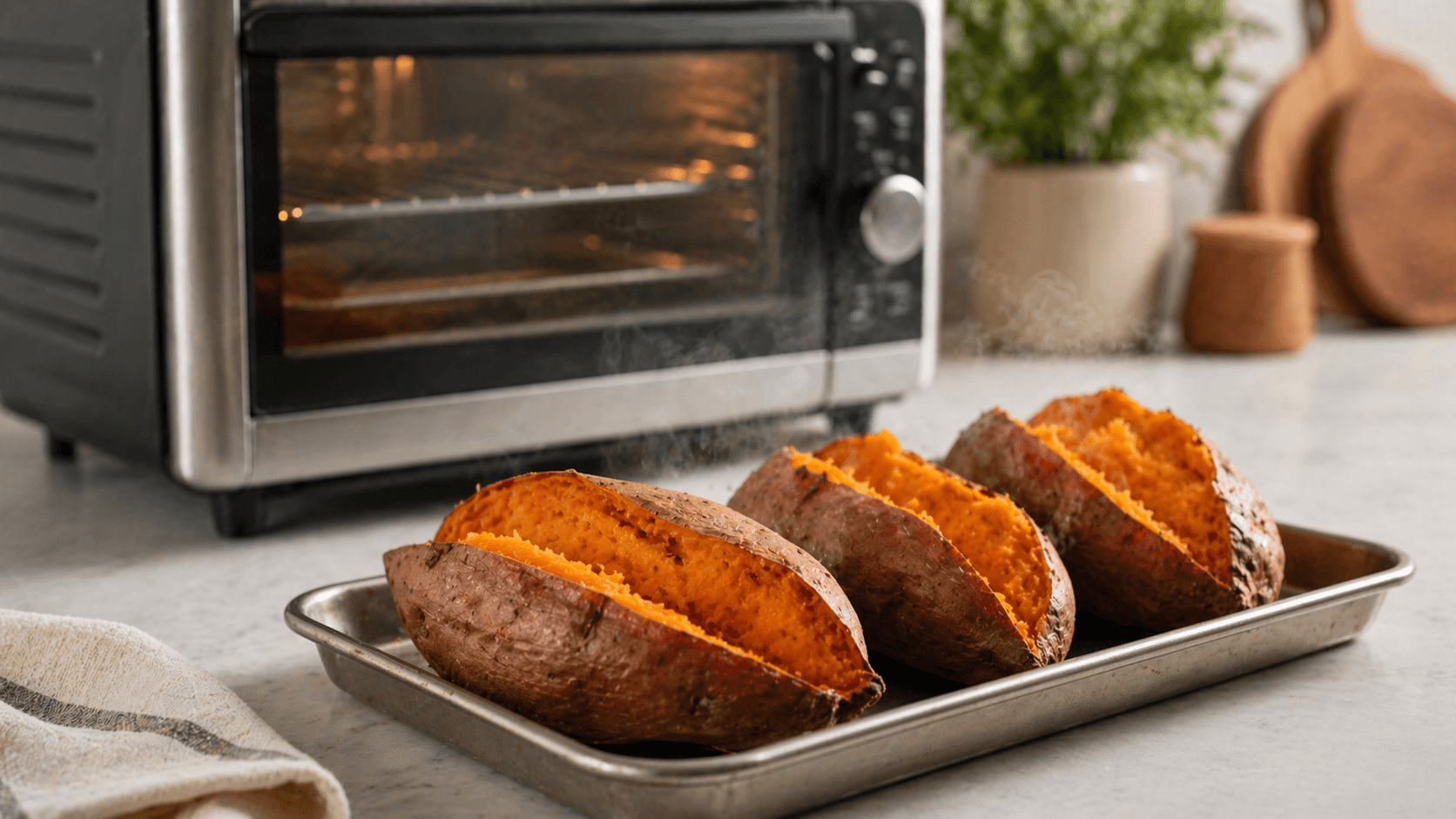
Baked sweet potatoes in a Breville Smart Oven with fluffy centers, lightly crisp skins, convection timing, and easy meal-prep storage.
Prep
5 mins
Cook
45 mins
Total
50 mins
Calories
112 kcal
Protein
2 g
Carbohydrates
26.2 g
Serves
4 servings
Fat
0.1 g
This method uses the Breville Smart Oven’s convection to turn whole sweet potatoes into fluffy-centered, lightly crisp-skinned sides without heating a full oven. Dry the skins, poke to vent steam, bake at 400 F (convection if available), and cook until a knife slides in easily. It’s a reliable base for sides, bowls, and loaded potato dinners.
Sweet Potatoes in a Breville Smart Oven score well as a simple whole-food side. Like the roasted sweet potato recipe, the main limitation is that this is still a starchy side rather than a full meal on its own.
Based on the recipe as written and estimated nutrition per serving. This score offers comparison context, not individualized health advice.
Countertop convection moves hot air across the potatoes, thinning the boundary layer so moisture escapes faster and the skins roast instead of steam. Poking creates controlled vents that limit splitting and syrupy leaks. Baking unwrapped at 400 F balances interior tenderness with surface dehydration; turning once evens heat exposure. Doneness depends on potato size and internal gelation of starches, not the clock.
Breville Smart Oven
Sheet pan or rimmed tray
Wire rack that fits the tray (optional, improves airflow)
Fork or thin skewer (for piercing)
Tongs (for turning and doneness squeeze test)
Parchment or foil (optional, for easier cleanup)
Instant-read thermometer (optional; interior tenderness typically aligns with the high-190s F and above)
Ingredient notes
Medium sweet potatoes are easiest to time in a countertop oven.
Avocado oil helps crisp the skin but is optional.
Sea salt is optional before baking; you can also season after splitting the potatoes.
Drying the skins before baking helps them roast rather than steam.
Prep potatoes
Pierce each potato with a fork. Rub with optional oil and salt for a crisper skin.
Set the oven
Use the Bake setting at 400 F with convection on if available.
Bake
Bake 40 to 50 minutes depending on size, turning once halfway through.
Check doneness
Potatoes are ready when a knife slides in easily and centers are soft.
Serve
Split open, fluff with a fork, and add toppings you like.
Per-serving details
Nutrition Facts
4 servings per container
Amount per serving
Calories
112
Protein 2 g
Per batch: 8.2 g
Total Fat 0.1 g
Per batch: 0.3 g
0%
Saturated Fat 0 g
Per batch: 0.1 g
0%
Total Carbohydrate 26.2 g
Per batch: 104.6 g
10%
Fiber 3.9 g
Per batch: 15.6 g
14%
Cholesterol 0 mg
Per batch: 0 mg
0%
Sodium 72 mg
Per batch: 286 mg
3%
Vitamin A 922 mcg
Per batch: 3687 mcg
102%
Vitamin C 3 mg
Per batch: 12 mg
3%
Vitamin E 0.3 mg
Per batch: 1.4 mg
2%
Calcium 39 mg
Per batch: 156 mg
3%
Iron 0.8 mg
Per batch: 3.2 mg
4%
Magnesium 33 mg
Per batch: 130 mg
8%
Potassium 438 mg
Per batch: 1752 mg
9%
* The % Daily Value tells you how much a nutrient in a serving of food contributes to a daily diet. 2,000 calories a day is used for general nutrition advice.
Nutrition is an estimate and varies by sweet potato size and whether you use oil.
Skipping the oil lowers the fat estimate slightly.
Nutrition information is automatically calculated, so should only be used as an approximation.
Optional recipe science
Sweet potatoes: Starch gelatinizes and pectin softens as the interior climbs past roughly the mid-190s F, creating a creamy texture. Natural amylase enzymes are active in the warm-up phase and convert some starch to maltose, increasing sweetness without added sugar. Dry, unwrapped skins dehydrate in convection, concentrating flavor and improving bite; fork holes vent steam to prevent bursting. Size is the main driver of bake time.
Avocado oil: Optional. A thin film improves heat transfer and evaporation at the surface, encouraging a more blistered, crisper skin. It also helps absorb fat-soluble carotenoids in the orange flesh. Too much oil can inhibit evaporation and soften the skin, so keep it light.
Sea salt: Optional. Pre-bake salting seasons the skin and can draw a little surface moisture to aid dehydration. It doesn’t speed interior cooking; use lightly (or season after baking) to keep sodium measured.
Dry skins roast: Surface water must evaporate before browning can happen; patting dry speeds this phase.
Enzyme-driven sweetness: During the climb to finishing temperature, amylases convert some starch to maltose, so longer, steady baking yields naturally sweeter flesh.
Skin texture control: Unwrapped potatoes dehydrate and lightly blister; foil traps steam and softens the skin.
Convection vs. no convection: Convection typically shortens cook time and improves surface drying; without it, expect a slightly longer bake and softer skins unless you extend time.
Size dominates timing: Medium potatoes often finish in 40–50 minutes at 400 F; small ones sooner, large ones later. Use a knife test rather than chasing an exact minute.
Plate balance: Serve with protein (beans, eggs, chicken, fish) and a green vegetable to keep the whole meal steadier and more filling.
Keep toppings savory: Olive oil, Greek yogurt, herbs, chili, or tahini add richness and complexity without pushing the dish toward dessert.
Salt strategy: Season lightly on the skin or finish with a pinch after baking to control sodium.
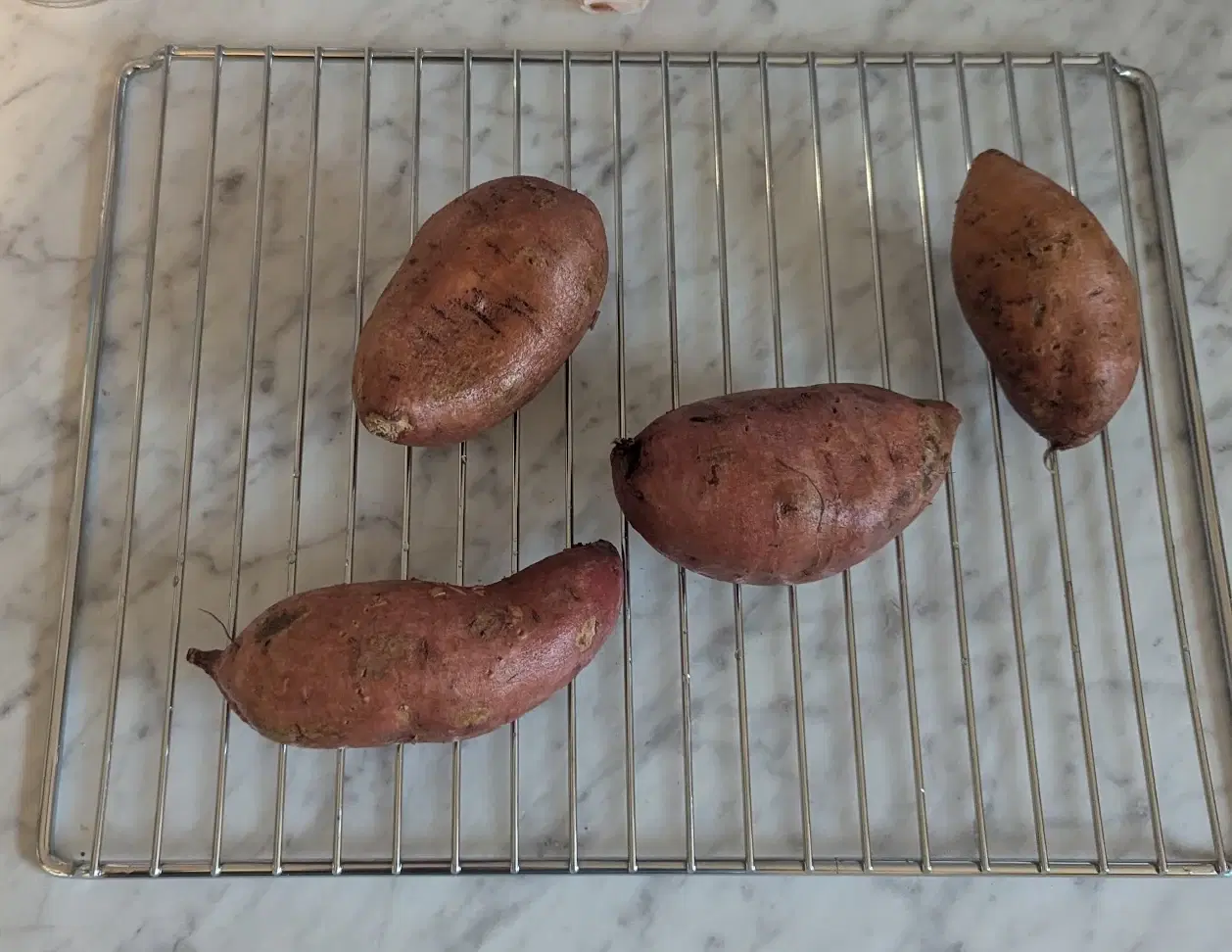
Airflow boost: Set potatoes on a rack over a tray to dry the skins more efficiently.
Batch cook: Bake several at once for fast breakfasts and bowls; reheat in the Breville to restore skin texture.
Dry, poke, bake at 400 F with convection if available, and cook until a knife meets little resistance.
Skip foil for crisper skins; turn once for even heating.
Treat sweet potatoes as a side, then complete the plate with protein and greens.
Optional adjustments
Explore lower-sodium, higher-fiber, or more plant-forward variations.
Use these changes to make the sweet potatoes a stronger part of a full meal.
Choose a change to preview how the sweet potatoes improve when the plate around them gets more complete.
Start with one or two upgrades to preview how the recipe improves.
Keep this recipe handy
Tips, variations, storage advice, and quick fixes—all in one place.
Cool baked sweet potatoes for about 10 minutes, then refrigerate whole (un-split) for up to 4 days to limit moisture loss.
Reheat in the Breville at 350 F for 10 to 12 minutes to revive skin texture.
Microwave when speed matters; expect a softer skin.
Mash and freeze portions for up to 2 months; thaw overnight in the fridge and reheat gently.
Make it savory
Top with Greek yogurt, chives, and black pepper.
Olive oil, flaky salt, and chili flakes with a squeeze of lemon.
Tahini, parsley, and toasted sesame seeds.
Make it sweet
Add cinnamon and a small drizzle of maple syrup.
Almond butter, chopped pecans, and a pinch of sea salt.
Stuffed and balanced
Black beans, pico de gallo, and yogurt or crema-style topping.
Shredded rotisserie chicken, olive oil, lemon, and herbs.
I start checking medium potatoes around 40 minutes because countertop convection often cooks faster than a full-size oven.
For meal prep, I bake similar-size potatoes together and label the container with the date before refrigerating.
For the crispiest skins, I set the potatoes on a rack over a tray so air can circulate all around.
Skins scorch before centers are tender: lower the oven to ~390 F and continue until the centers soften.
Centers are still firm at the suggested time: bake in 5-minute increments and rely on the knife test, not the clock.
Skins are too soft: bake unwrapped, dry the potatoes better before cooking, and increase airflow with a rack.
Potatoes finish at different times: remove the tender ones and continue baking the larger ones.
Syrup leaks and burns on the tray: line the pan with parchment or foil and clean the crumb tray afterward.
Uneven browning: turn the potatoes and rotate the tray; avoid overcrowding so convection can work.
How long do sweet potatoes take in a Breville Smart Oven?
Most medium sweet potatoes take 40 to 50 minutes at 400 F. Small potatoes may finish sooner, and large potatoes can take closer to 55 to 65 minutes.
Should I use Bake or Roast for sweet potatoes in a Breville?
Bake at 400 F with convection on is the most reliable default. Roast can work too, but watch the skins because they may brown faster.
Do I need to wrap sweet potatoes in foil?
No. Baking unwrapped gives better skin texture. Use foil only if you prefer softer skins or want easier cleanup.
How do I know baked sweet potatoes are done?
They are done when they feel soft when squeezed gently with tongs and a knife slides into the center with little resistance.
Can I meal prep Breville baked sweet potatoes?
Yes. Refrigerate baked sweet potatoes for up to 4 days and reheat them in the Breville, microwave, or a regular oven before serving.
Why poke holes before baking?
Piercing creates vents for steam. It reduces the chance of splitting and helps the skins dry instead of ballooning and steaming.
What is the benefit of convection for this recipe?
Convection increases air movement, which speeds moisture evaporation from the skins. That improves skin texture and can shorten total bake time slightly.
Some recipes include affiliate links to products we genuinely use and recommend. If you purchase through these links, we may earn a small commission at no extra cost to you, which helps keep our recipes free to access.
See what other cooks think and share your own tips.
Want to leave a review?
Sign in with your account to rate this recipe and share your notes.
Loading reviews…