Breakfast
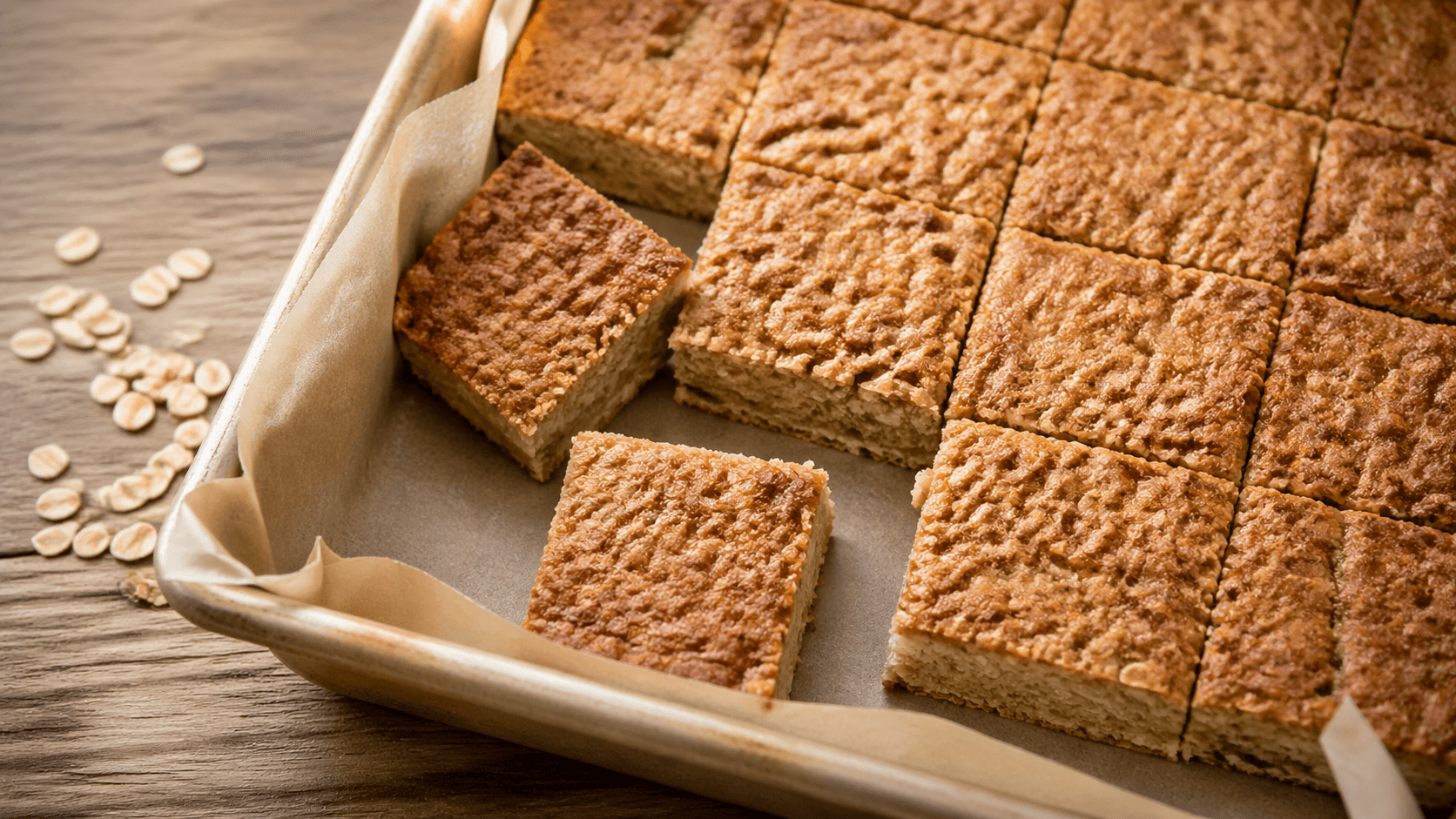
Protein-forward sourdough discard breakfast bars with collagen, Greek yogurt, oats, chia, flax, blueberries, and a soft meal-prep texture.
Prep
10 mins
Cook
24-28 mins
Total
34-38 mins
Calories
284 kcal
Protein
17.8 g
Carbohydrates
30.9 g
Serves
10 bars
Fat
9.7 g
A one-bowl, protein-forward bar built from sourdough discard, Greek yogurt, eggs, and collagen. Oats plus chia/flax supply structure and fiber, while applesauce and blueberries keep the crumb tender. It’s designed for clean slices and reliable meal prep.
Leavening and set: This bar relies on eggs for coagulation and a small dose of baking soda to neutralize the acidity of sourdough discard and yogurt. That reaction generates modest lift while keeping the texture closer to a soft oatmeal bar than a cookie or granola bar.
Hydration and gel network: Rolled oats, chia, flax, and collagen all bind water. A 5-minute bench rest lets soluble fibers (chia mucilage and oat beta-glucans) and proteins pre-hydrate so the batter bakes evenly without wet pockets.
Tenderizing vs. structure: Applesauce and oil tenderize; collagen and egg proteins firm. The formula deliberately balances these so the bars slice cleanly after cooling but stay soft for breakfast.
Acidity management: Sourdough discard and yogurt are acidic. Baking soda partially neutralizes acidity, improving browning and mellowing tang while protecting blueberry color.
Large mixing bowl
Whisk
Spatula or spoon
9 x 13 inch metal baking pan
Parchment paper (with overhang for easy lifting)
Toaster oven or conventional oven (350 F)
Cooling rack (helpful)
Offset spatula or butter knife for smoothing (optional)
Ingredient notes
Sourdough discard adds moisture and mild tang without needing fermentation time.
Greek yogurt adds protein and helps keep the bars tender.
Collagen peptides increase protein without a strong flavor, but too much can make bars firm.
Oats, chia, and flax help the bars hold together and make them more filling.
Blueberries add freshness and moisture; smaller berries distribute more evenly.
Preheat the oven
Preheat the oven to 350 F and line a 9 x 13 pan with parchment paper.
Mix the wet ingredients
Whisk the wet ingredients together until smooth.
Stir in the dry ingredients
Stir until the batter is evenly combined.
Fold in the fruit
Fold in the blueberries, then let the batter rest for 5 minutes so the chia can hydrate.
Spread in the pan
Spread the batter evenly into the prepared pan.
Bake
Bake for 24 to 28 minutes, until the center is set and the edges are lightly golden.
Cool and slice
Cool completely, then slice into 10 bars.
The batter thickens as the chia, flax, oats, and collagen absorb moisture, so a short rest before baking improves texture and structure.
Per-serving details
Nutrition Facts
10 bars servings per container
Amount per serving
Calories
284
Protein 17.8 g
Total Carbohydrate 30.9 g
11%
Total Fat 9.7 g
12%
* The % Daily Value tells you how much a nutrient in a serving of food contributes to a daily diet. 2,000 calories a day is used for general nutrition advice.
Protein quality note: collagen is an incomplete protein; pair with eggs/yogurt (already included) or replace part of the collagen with whey/soy isolate for a more complete amino-acid profile.
Nutrition information is automatically calculated, so should only be used as an approximation.
Optional recipe science
Eggs: Primary coagulating protein for structure; emulsify fats and liquids; contribute moisture and browning.
Collagen peptides: Boost protein and firm the crumb as water leaves; overuse can make bars rubbery, so it’s balanced with yogurt, applesauce, and oil.
Plain Greek yogurt: Adds complete dairy protein and acidity; tenderizes and retains moisture for a softer slice.
Sourdough discard: Provides water and starch with mild acidity and tang; acidity helps react with baking soda for lift and better browning.
Rolled oats: Bulk and chew; starches absorb water and help bars hold together; beta‑glucans add viscosity and fiber.
Oat flour: Finer particle size increases water absorption and cohesive crumb; supports clean slicing.
Unsweetened applesauce: Water and pectin for tenderness with minimal added sugars; supports moist texture.
Blueberries: Juicy inclusions with polyphenols; add localized moisture and brightness.
Chia seeds: Hydrocolloid gel forms during rest and baking; raises water binding and fiber; improves slice integrity.
Ground flaxseed: Adds fiber and lipids (including ALA) for structure and satiety; helps reduce crumbling.
Olive oil or avocado oil: Tenderizes, limits gluten development from the starter flour portion, and improves fat quality.
Maple syrup or honey: Light sweetness to keep the bar breakfast‑friendly; minor humectant effect for moistness.
Vanilla extract: Volatile aromatics that reinforce perceived sweetness without extra sugar.
Baking soda: Neutralizes batter acidity; drives modest CO₂ for lift and improves Maillard browning.
Cinnamon: Aromatic spice; contributes antioxidant compounds and perceived sweetness without sugar.
Salt: Heightens flavor and balances sweetness; a small pinch controls overall sodium.
Rest window: In 5 minutes, chia hydrates and forms a hydrocolloid gel; oats begin absorbing free water; collagen disperses fully. Skipping the rest can leave the center loose at the standard bake time.
Protein setting: Eggs set between roughly 160–180 F; that’s when the bar stops jiggling. Collagen contributes to firmness as water evaporates during cooling—hence the recommendation to cool completely before slicing.
pH and soda: Sourdough discard plus yogurt drop batter pH. Baking soda neutralizes part of that acidity, improving Maillard browning and flavor balance. Too much soda would taste soapy and over-brown; the listed amount is calibrated for this acid load.
Water activity: Applesauce and blueberries raise moisture and total water. Oat flour plus rolled oats increase starch surface area, pulling water into the crumb so bars hold together after chilling.
Protein quality: Collagen is incomplete. Keeping the eggs and Greek yogurt maintains more complete amino acids. If you want to improve protein quality further, replace part of the collagen with whey or soy isolate without changing the method.
Glycemic gentleness: The bar already keeps added sweetener modest. For an even steadier response, reduce the maple/honey to 1 tablespoon or use a suitable allulose/erythritol blend and add 1 tablespoon psyllium husk (increase liquid ~20–30 g).
Fat quality: Default to extra‑virgin olive oil to prioritize monounsaturated fats and polyphenols over refined fats.
Mapping hygiene: When you run nutrition again, ensure the starter is logged as 120 g water + 120 g flour, eggs are set to 150 g edible, oat flour maps to whole‑grain oat flour, applesauce is unfortified, and oil maps to EVOO or avocado oil. This avoids false sodium spikes and reflects the intended fat profile.
Score interpretation: Relative to typical breakfast bars, this build trends favorable on overall balance, longevity-supporting patterns, and metabolic friendliness. Inflammation remains more neutral until mapping is fully corrected and EVOO is credited properly.
Rest the batter, bake until set at the center, and cool fully before slicing. That sequence is what makes a high‑moisture, fiber‑rich bar slice cleanly for meal prep.
Keep this recipe handy
Tips, variations, storage advice, and quick fixes—all in one place.
Refrigerate, covered, 4–5 days. Bars slice and hold best after chilling.
Freeze individually wrapped bars up to 2 months.
Thaw overnight in the fridge or warm gently from frozen.
Reheat lightly (toaster oven or microwave) just until warm to avoid drying.
I get the cleanest cuts by chilling the baked slab, then briefly warming individual bars just before eating.
If packing for kids, I cut smaller rectangles and include yogurt or milk to round out protein.
Center underbaked: Bake 2–4 minutes longer and confirm the center no longer jiggles; ensure the 5‑minute batter rest wasn’t skipped.
Bars seem dense: Mix just until combined after adding oat flour and collagen; overmixing compacts the crumb.
Crumbly when warm: Cool fully or chill before slicing; collagen and egg need time to set.
Excess tang: Use fresher discard or add 1 extra tablespoon maple/honey to balance acidity.
Blueberries sinking: Lightly dust berries with a spoon of oat flour before folding, and avoid big pockets of fruit.
Some recipes include affiliate links to products we genuinely use and recommend. If you purchase through these links, we may earn a small commission at no extra cost to you, which helps keep our recipes free to access.
See what other cooks think and share your own tips.
Want to leave a review?
Sign in with your account to rate this recipe and share your notes.
Loading reviews…
Scores will refresh after correcting nutrition inputs (eggs set to 150 g edible, starter logged as 120 g water + 120 g flour, oat flour remapped to whole grain, oil set to extra-virgin olive oil or avocado oil, applesauce unfortified). Expect sodium to drop and the ingredient-balance score to improve; protein may moderate slightly.
Based on the recipe as written and estimated nutrition per serving. This score offers comparison context, not individualized health advice.
Optional adjustments
Explore lower-sodium, higher-fiber, or more plant-forward variations.
Tune this bar for your goals—boost complete protein, raise fiber, reduce added sugars, or create a gluten‑free pathway—without changing the core method.
Preview how simple tweaks affect practicality and nutrition after we refresh USDA mappings.
Start with one or two upgrades to preview how the recipe improves.