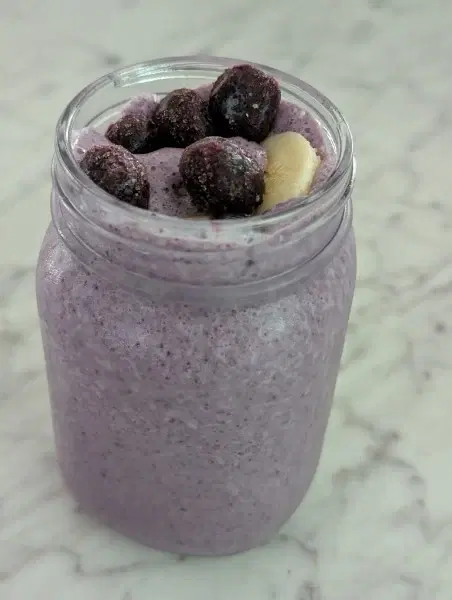
A creamy blueberry banana kefir smoothie with Greek yogurt, chia seeds, and mild probiotic flavor that works well for both kids and adults.
Prep
10 mins
Cook
0 mins
Total
10 mins
Calories
201 kcal
Protein
9.5 g
Carbohydrates
27.3 g
Serves
5 servings
Fat
6.2 g
A practical, science-forward smoothie: ripe bananas supply natural sweetness and body, blueberries bring color and polyphenols, kefir and Greek yogurt add protein and a gentle tang, and chia seeds thicken for lasting fullness. Kefir is a fermented milk drink rich in live cultures, protein, and calcium.
Moderate-protein, fiber-aided smoothie with blueberry polyphenols and live-culture potential. Sugars come from fruit and dairy lactose; saturated fat depends on milk/yogurt choices. Portion size strongly affects per-glass impact.
Based on the recipe as written and estimated nutrition per serving. This score offers comparison context, not individualized health advice.
This smoothie balances sweetness, acidity, and viscosity using simple food-science levers. Ripe bananas bring natural sugars and pectin for body; frozen blueberries supply Anthocyanins that deepen color and add a restrained tartness; kefir and Greek yogurt introduce protein and a lactic tang that keeps banana sweetness from tasting cloying; and chia seeds absorb liquid to create a gentle gel that prolongs fullness. The ice moderates temperature and viscosity without adding calories, while milk sets overall drinkability.
Kefir vs. Yogurt vs. Milk: What Changes in the Glass?
| Base | What it adds | Notes |
|---|---|---|
| Kefir | Mild tang, live cultures, slight effervescence | Use 1/4–1/2 cups to keep flavor kid-friendly; verify “live & active cultures.” |
| Greek yogurt | Protein, creaminess, lactic acidity | Whole-milk version is richer; low-fat keeps protein with less saturated fat. |
| Milk (2% default) | Dilution control, lactose sweetness, minerals | Swap to soy milk for more protein; 1% milk for less saturated fat. |
Using a small, flexible amount of kefir gives probiotic potential without overwhelming fruit flavor. Greek yogurt supplies most of the protein and the thick, spoonable texture. Milk adjusts thickness and helps the blender generate a stable vortex for a smooth puree.
Texture Science: How Chia Thickens
Chia seeds can absorb several times their weight in liquid. Their mucilage—water-binding soluble fiber—forms a weak gel that increases viscosity and slows separation. In a smoothie, that means: thicker texture after a short rest, better suspension of berry skins, and a more even sip from first pour to last. If you blend 10–15 seconds longer, the seeds disperse more thoroughly and the drink turns satiny without tasting seedy.
Blueberries contribute anthocyanins—pigments that also bring a subtle astringency. Combined with the lactic acidity of kefir and yogurt, they keep two ripe bananas from reading as “dessert-sweet.” A small pinch of salt (sodium ions) can further enhance perceived sweetness by suppressing bitter notes, which is why it’s a better first adjustment than more sugar.
Within a reasonable portion, this build offers moderate protein from Greek yogurt and milk, fiber and plant omega-3s (ALA) from chia, and berry polyphenols. Sweetness comes primarily from bananas and dairy lactose; you can omit the optional added sweetener. If you prefer a lighter sugar profile, use one banana and add frozen riced cauliflower or peeled zucchini for bulk—these are neutral in flavor once blended.
Load liquids first (milk, kefir), then yogurt, bananas, blueberries, chia, and finally ice. Liquids first promote a stronger vortex and reduce cavitation around the blade.
Blend 30–45 seconds; you’re aiming for a glossy surface with a light dome that holds briefly when you stop the motor. That indicates enough shear to fully disperse chia and berry skins.
Taste. If it seems flat, add a tiny pinch of salt before reaching for sugar. If tang is high, use the lower kefir range or add a touch more banana.
For a thinner sip, add milk in 1–2 tablespoons increments; for thicker texture, either rest 3–5 minutes (chia hydration) or add more frozen fruit rather than extra ice to avoid dilution.
At 1/4 cups per batch, kefir’s flavor reads as a clean, yogurt-like brightness more than a pronounced tang. At 1/2 cups, acidity is noticeable but still balanced by two bananas and blueberries. If serving to kids or kefir beginners, start low and scale up across future batches.
Best flavor and aeration are within 10–15 minutes of blending.
Refrigerate leftovers up to 24 hours. Expect thickening as chia continues hydrating; shake or stir to re-suspend.
For true prep-ahead, freeze fruit and chia as packs. Add milk, kefir, yogurt, and ice at blend time for the freshest aroma.
Interested in the science behind these ingredients?
High-speed blender
Measuring cups
Measuring spoons
Flexible spatula (to scrape down the blender)
Lidded to-go cups or jars (for short-term storage)
Ingredient notes
Very ripe bananas provide the best natural sweetness.
Whole milk Greek yogurt creates the creamiest texture.
Frozen blueberries help chill the smoothie naturally.
Add the bananas, blueberries, chia seeds, vanilla extract, kefir, Greek yogurt, milk, and ice cubes to a high-speed blender.
Blend on high for 30 to 45 seconds until smooth and creamy.
Taste the smoothie and adjust sweetness if desired.
Add additional milk if you prefer a thinner consistency and blend again briefly.
Serve immediately.
Adding the liquid ingredients near the blender blades helps the smoothie blend more evenly.
Frozen blueberries and ice help create a cold, thick texture without needing added ice cream or frozen yogurt.
Chia seeds continue absorbing liquid after blending, naturally thickening the smoothie over time.
Per-serving details
Nutrition Facts
5 servings per container
Amount per serving
Calories
201
Protein 9.5 g
Total Carbohydrate 27.3 g
10%
Total Fat 6.2 g
8%
* The % Daily Value tells you how much a nutrient in a serving of food contributes to a daily diet. 2,000 calories a day is used for general nutrition advice.
This smoothie combines kefir, blueberries, bananas, and chia seeds to provide protein, fiber, and bioactive compounds such as anthocyanins.
Learn more about how kefir supports gut health in our detailed Kefir Benefits guide.
Nutrition information is automatically calculated, so should only be used as an approximation.
Optional recipe science
Bananas: Provide natural sweetness, creamy body, and pectin for viscosity that softens kefir’s tang.
Frozen blueberries: Supply color, berry aroma, anthocyanins, and slight astringency that balances banana sweetness.
Chia seeds: Add soluble fiber that hydrates into a light gel, boosting thickness and satiety over time.
Vanilla flavor/extract: Rounds acidity and enhances perceived sweetness via aroma-driven flavor enhancement.
Milk kefir: Contributes gentle lactic tang, live cultures (when labeled active), and a lighter drinkable dairy note.
Plain Greek yogurt: Primary protein source and thickener; lactic acidity sharpens fruit flavors and stabilizes texture.
Milk of choice: Sets overall drinkability and blender vortex; adds lactose sweetness and minerals.
Ice cubes: Lowers temperature and adds volume without calories; too much can dilute flavor.
Organic cane sugar or honey (optional): Fine-tunes sweetness; use sparingly after tasting to avoid oversweetening.
Optional adjustments
Explore lower-sodium, higher-fiber, or more plant-forward variations.
Toggle possible adjustments and preview how they shift the recipe's meal balance.
This is the kind of feedback users would see after making a few improvements.
Start with one or two upgrades to preview how the recipe improves.
Keep this recipe handy
Tips, variations, storage advice, and quick fixes—all in one place.
Best within 10–15 minutes after blending for peak aeration and aroma.
Refrigerate leftovers up to 24 hours; expect natural thickening as chia hydrates. Stir or shake before serving.
For make-ahead, portion all ingredients except liquids into freezer bags; add liquids and blend when ready.
Strawberry Banana Version
Green Smoothie Version
If using mostly fresh fruit, reduce ice and add a handful of frozen berries to avoid watery dilution.
For toddlers, use the lower kefir range and slightly less chia for a smoother sip.
Let the smoothie rest 2 minutes after blending if it tastes too sharp; slight warming mellows acidity.
Too thick: Add 2–4 tablespoons of milk and blend briefly; warming by a few degrees also loosens viscosity.
Too thin: Add more frozen fruit or an extra teaspoon of chia and blend; thickness increases further after 5–10 minutes.
Overly tangy: Use less kefir or add a bit more banana or vanilla to round edges.
Icy or watery: Reduce ice and rely on more frozen fruit to maintain thickness with less dilution.
Blender stalls: Pause, scrape down, add a splash more liquid, and start on low to re-establish a vortex.
Can I make this smoothie ahead of time?
Yes, though it’s best soon after blending. Chia continues hydrating and thickening over time; refrigerate up to 24 hours and stir or shake before drinking.
Can kids drink kefir smoothies?
Many kids enjoy kefir when the tang is kept mild with fruit and yogurt. Start with the lower kefir amount and increase gradually as taste preferences adapt.
Can I freeze this smoothie?
Yes. Freeze in portions and thaw in the fridge until slushy before blending or shaking to restore texture.
How do I boost protein without changing flavor much?
Use soy milk, keep Greek yogurt, or add an unflavored whey, casein, or pea protein scoop; blend well to avoid grit.
Score: 0/10 · 10 left
Question 1
What does the recipe's overallScore of 80 and label 'Stronger meal balance' most likely indicate?
Question 2
Which ingredient in this smoothie is noted for providing anthocyanins, compounds linked with antioxidant activity?
Question 3
The recipe mentions chia seeds contribute ALA omega-3s. What other functional role do chia seeds provide in the smoothie?
Question 4
What functional benefit does milk kefir potentially add to the smoothie, according to the recipe summary?
Question 5
The recipe's metabolic metric notes moderate protein (~9–10 g/serving). Which ingredient is the primary contributor to that protein level?
Question 6
Why does the recipe suggest choosing 0–2% Greek yogurt or fortified unsweetened soy milk as an improvement?
Question 7
What role do ripe bananas play in the smoothie beyond sweetness?
Question 8
The inflammation metric highlights a potential downside from using whole-milk yogurt + 2% milk. What is that downside?
Question 9
Which suggested addition is intended to boost soluble fiber and thickness in the smoothie?
Question 10
Why does the recipe recommend skipping the optional added sweetener as a quick improvement?
Some recipes include affiliate links to products we genuinely use and recommend. If you purchase through these links, we may earn a small commission at no extra cost to you, which helps keep our recipes free to access.
See what other cooks think and share your own tips.
Want to leave a review?
Sign in with your account to rate this recipe and share your notes.
Loading reviews…